

The Virginia Museum of Fine Arts (VMFA) is traveling through Virginia to bring American history to communities around the Commonwealth. The exhibition “Virginia as America: Navigating ‘Life, Liberty, and the Pursuit of Happiness’” lives upon the Artmobile and stopped in Ashland last week.
The exhibition was curated by Susan J. Rawles, Ph.D., the VMFA’s Elizabeth Locke Associate Curator of American Decorative Arts and highlights Virginia’s part in the 250th anniversary of the American Revolution.
“Virginia was very much a leading voice in the American narrative,” Rawles said, “To emphasize its place in the birth of the new Republic seemed both meaningful and relevant.”
The narrative has been carefully curated by Rawles using “cultural context of an object’s making—the who, when, and why.” The intersection of historical and contemporary works highlights the everlasting foundation of American principles.
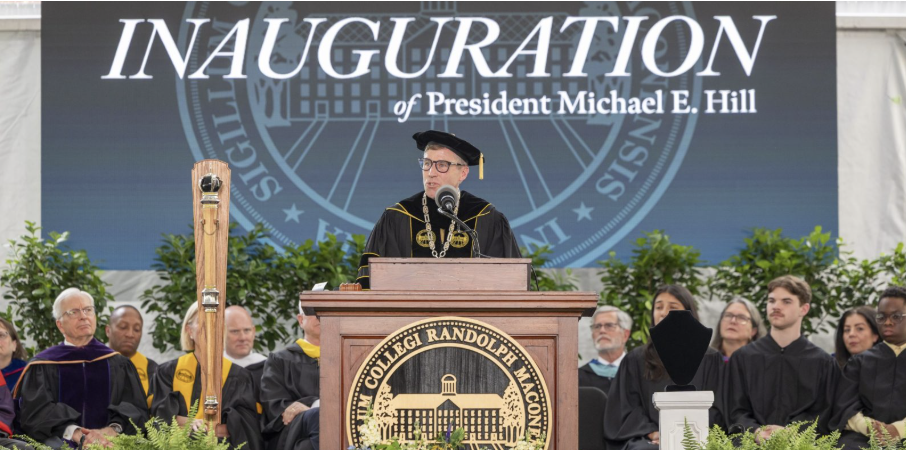
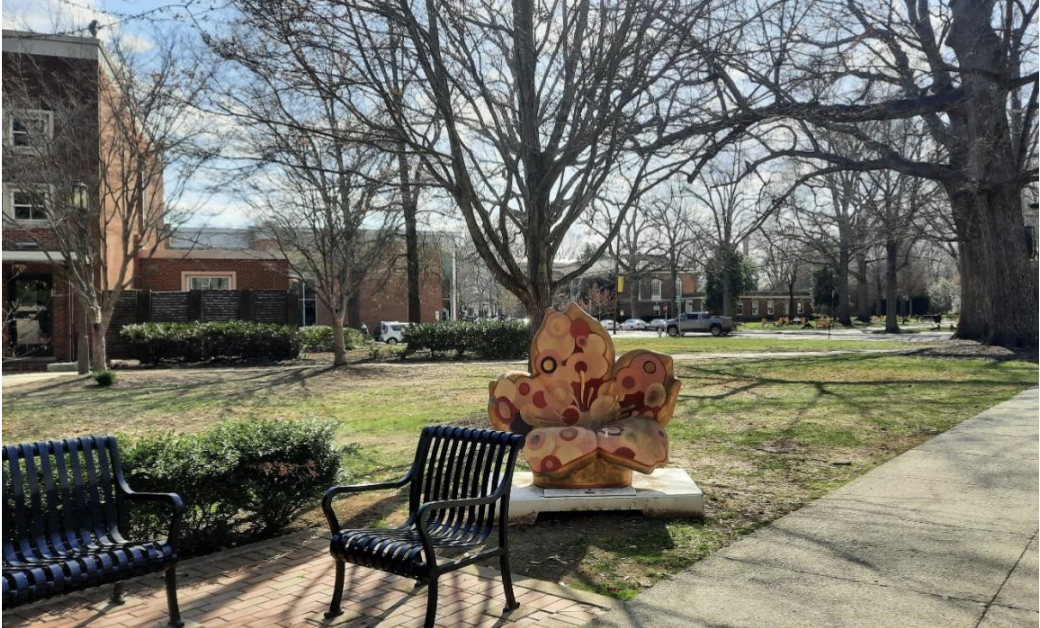
When perceiving history in the modern day, the artistic perspective becomes increasingly relevant. Dr. Evie Terrono, Professor of Art History at Randolph-Macon, worked to bring the event to campus alongside the VMFA. This was the first of its kind visit to campus, which she hopes to make a tradition in years to come.
“The idea was to congregate, obviously, the community,” Dr. Terrono described, “Not only our college community, but also the broader [Ashland] community.”
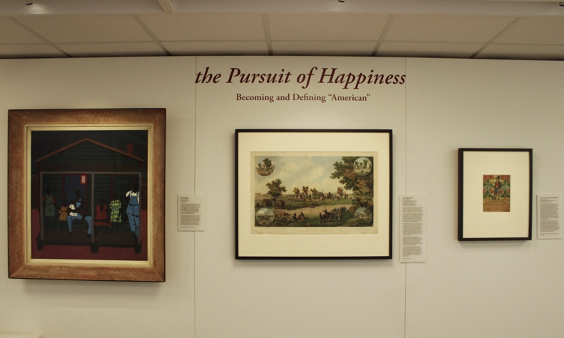
Comprised of 14 works from the VMFA collection, the exhibition is organized in two parts: “The Promise” and “Conflicts and Consequences”. Each part contains three themes: Life, Liberty, and the Pursuit of Happiness.
The introduction of historical perspective in a contemporary setting allowed Randolph-Macon community members to look back in a new light. “Interpretations of historical facts can shift according to new scholarship,” Dr. Terrono explained, “perhaps in response to cultural shifts and sociopolitical pressures.”
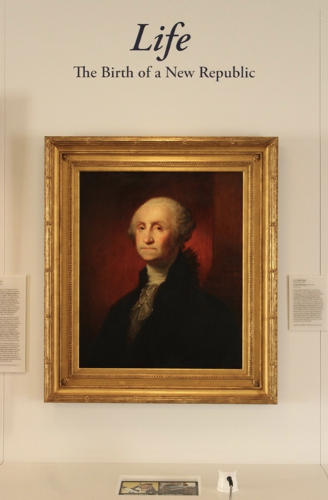
The first part of the exhibition displays the ‘Life’ of America, highlighting early operations in establishing a new Republic of America and the displacement of Indigenous Americans in the process. “We also hope that the story of settlement from the coast to the inland, and the diversity of cultures that met there, will be meaningful,” Rawles shared.
Highlighted pieces include a 19th century portrait of former President George Washington and a contemporary oil painting of Walter Bradby, chief of the Pamunkey Tribe in the 1930s.
Following the sequence, ‘Liberty’ is translated through artifacts surrounding individual rights and contrasted with works about slavery and abolition. “[History] tells us where we have been, cautions us against our human weaknesses,” Rawles stated, “And guides us to greater achievement.” An engraving of James Madison, “Father of the Constitution”, and preservation of a slave-carved pendant hope to redefine the idea of the “American Identity”.
Wrapping up, audiences are immersed in different perspectives of the American ‘Pursuit of Happiness’. The section focuses on the idea of “the opportunity to live freely, safely, and independently in unity,” Rawles described. Ending the exhibition with a print of Dr. Martin Luther King Jr. at the United Nations in 1967 leaves viewers with a reflection inducing image of how these ideas have evolved through American history.
It is Rawles’ hope to bring a meaningful interpretation of Virginia’s historical impact in the building process of our nation. She intends for her artistic eye, accompanied by modern events, to welcome a different lens into history across rural and urban Virginia alike.
Dr. Terrono hoped to give attendees a new perspective into the world of art curation. She welcomed a multitude of academic departments to the event, including computer science and communication studies. She specified that artists “create a sense of narrative continuity, and this is particularly more effective in a relatively smaller space, such as this.”
“Art is about crafting and redrafting,” Rawles said, adding, “If we learn properly from our past, we can forge a better future.”
The exhibition will continue its journey across Virginia through December 2026, but visitors may attend at its permanent stay at the VMFA in Richmond.